
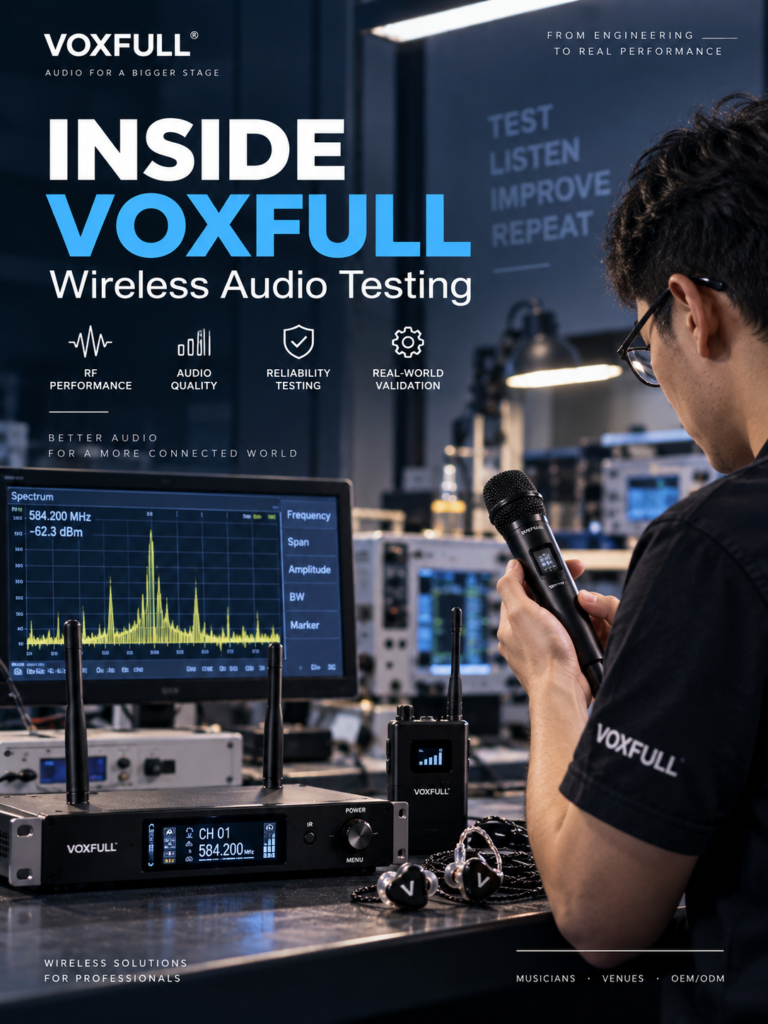
Behind the Product · VOXFULL Insights
A wireless audio product can power on, produce sound and still not be ready for a live stage.
That is something we have learned repeatedly while working with wireless microphones and wireless in-ear monitoring systems.
For a wired audio product, finding a problem can sometimes be relatively straightforward. With wireless audio, the problem may only appear when the transmitter moves farther away, when another RF system is switched on, when the bodypack changes position, or after the product has been operating for some time.
So at VOXFULL, when we talk about testing a wireless audio system, we are not talking about one single test.
We are looking at several things together:
RF performance. Audio performance. Frequency operation. Wireless stability. Hardware function. And finally, how the product behaves when somebody actually uses it.
Here is what that looks like in practice.
Testing Starts Before Mass Production
For us, testing doesn’t begin at the end of the production line.
It starts when we evaluate a new product platform.
This is particularly important for wireless IEM systems.
A specification sheet can look excellent:
- Long transmission distance
- Low latency
- Stereo audio
- Multiple channels
- High RF output
- Automatic frequency scan
But those numbers alone don’t tell us whether the product is something we want to sell.
When we evaluate a new wireless platform, we first need to understand whether the basic RF and audio architecture makes sense. Then we build samples, test functions and make adjustments before deciding how the product should be positioned.
Sometimes that process also changes the product itself.
A compact 2.4GHz IEM, for example, should not be evaluated in exactly the same way as a professional 1U UHF monitoring system. The first product may prioritize portability and simple operation; the second needs much more attention to frequency management and multi-system use.
Different products have different jobs, so the test has to reflect the job.
1. RF Testing: A Wireless Product Is an RF Product First
This is one of the most important differences between wireless audio and conventional audio equipment.
Before worrying about how beautiful the microphone sounds, the RF link has to work properly.
For our UHF wireless systems, we use RF test equipment to inspect the transmitted signal and check whether the product is operating where it is supposed to operate.
Depending on the product and development stage, this can include checking:
Operating frequency
Is the transmitter actually working at the programmed frequency?
RF output
Is the transmitted RF power behaving as expected?
Frequency switching
When the user changes channels, does the RF section follow correctly?
IR synchronization
Does the receiver/transmitter synchronize to the intended frequency?
Frequency scan
On products equipped with scanning, does the function correctly support frequency selection?
These are particularly important on multi-frequency UHF products.
If a system has 100 or 200 selectable frequencies, checking only one channel doesn’t tell the whole story.
Why We Use a Spectrum Analyzer
A spectrum analyzer gives us something our ears cannot.
It lets us see the RF signal.
When one of our technicians holds a wireless microphone in front of a spectrum analyzer, the purpose is not to “test the sound” with the screen.
We are observing what is happening in the radio-frequency domain.
That distinction is important.
Audio testing and RF testing are related, but they are not the same test.
For a company working increasingly with wireless monitoring systems, we think this RF capability becomes more important as the product line develops.
A simple one-transmitter system is one thing.
Several wireless microphones and several IEM transmitters operating on the same stage is another.
2. We Test the Audio Path Separately
Once the RF connection is working correctly, there is still an audio system underneath it.
For wireless microphones, we listen for things such as:
Noise
Distortion
Output level
Frequency response
Unexpected artifacts
Mute/unmute behavior
For wireless IEM systems, there are additional things to pay attention to.
The performer is listening directly through earphones, often at relatively high sensitivity. Small amounts of background noise that may be less noticeable through a PA speaker can become much easier to hear through an IEM.
Stereo products also introduce another question:
Are the left and right channels actually behaving correctly?
That means checking the audio path rather than simply seeing a “Stereo” icon on the display.
3. With IEM, We Put the Earphones On
This is one of the simplest tests we do, but also one of the most useful.
We actually listen to the system.
When evaluating a wireless IEM, we connect an audio source, put on the receiver and listen while operating the system.
For a digital platform, latency is particularly important.
A laboratory number is useful, but monitoring is ultimately a human experience.
So one practical test is very simple:
Speak into a microphone and listen through the IEM.
Does the voice feel immediate?
Does anything feel strange?
What happens when the mix changes?
How does stereo separation feel?
Does noise become noticeable when there is no music playing?
This doesn’t replace measurement.
But measurement doesn’t replace this test either.
A wireless IEM is built for a musician, not for a test instrument.
4. Open-Area Range Testing — and Why We Say “Open Area”
You’ll notice that on some VOXFULL specifications we describe wireless distance as:
“Up to 80–100m in open area”
rather than simply:
“100m range.”
There is a reason.
When we carry out an open-area distance test, we are trying to create a relatively clean reference condition. The transmitter stays in one location while the receiver moves farther away.
We observe when the RF performance begins to change and whether audio remains usable.
But we don’t consider that number a promise that every customer will receive exactly the same distance inside every venue.
A real stage may contain:
- Metal structures
- LED walls
- Wi-Fi equipment
- Other wireless microphones
- Other IEM systems
- Audience smartphones
- Walls and obstacles
- Hundreds of human bodies
All of these can change the RF environment.
So when we state an open-area range, “open area” is part of the specification, not small print we want the customer to ignore.
5. Movement Matters
This becomes especially important with wireless IEM receivers.
A rack transmitter normally stays still.
The receiver doesn’t.
It may be attached to the waist of a singer who is moving across the stage, turning around, bending down or standing between the transmitter and other performers.
The human body itself can affect RF propagation.
So a useful wireless test cannot consist entirely of putting a transmitter and receiver on the same workbench.
We want to know what happens when the product moves.
That means walking with the receiver, changing its orientation and observing whether reception remains consistent.
For us, this is particularly relevant when evaluating different receiver antenna designs and higher-level RF architectures.
6. One System Working Is Not the Same as Several Systems Working
This is where professional wireless audio becomes more interesting.
Put one wireless microphone on a table.
Switch it on.
Everything works.
Now switch on another.
Then another.
Add several wireless IEM transmitters.
The RF environment has changed.
This is why the number of systems a customer intends to use matters when we discuss a project.
A product designed for:
one singer + one receiver
does not have the same requirements as a system intended for:
multiple microphones + several independent IEM mixes + other wireless equipment
As our VOXFULL monitoring range develops toward professional multi-channel and higher-level RF systems, this kind of system-level testing becomes increasingly important.
We don’t want to evaluate every wireless product as if it will always operate alone.
Real stages rarely stay that simple.
7. We Check the Functions the Customer Will Actually Touch
RF engineering is important, but many problems customers experience are much simpler.
A button.
A battery contact.
A connector.
A belt clip.
A display.
A volume knob.
These things don’t look impressive in a product brochure, but they determine whether the product is convenient and reliable in daily use.
For a wireless microphone, our functional checks can include:
Power on/off
Channel switching
IR sync
Mute operation
Display
Battery contact
Audio output
Buttons and controls
For an IEM receiver:
Power and volume control
Channel/frequency operation
Stereo/Mono operation
Headphone output
Display and battery indication
Buttons
Belt clip and physical assembly
This part of testing is less glamorous than looking at a spectrum analyzer.
It is also where many real customer problems begin.
8. Sometimes a Customer Finds Something We Didn’t
This is another part of quality control that manufacturers don’t talk about very often.
No factory should pretend that production testing means a product can never develop a problem.
We have had cases where customers reported an intermittent issue that did not appear on the samples we had in our hands.
Those cases are useful because they force us to move beyond:
“Our sample works.”
Instead, the questions become:
What exactly triggers the failure?
Is it electrical, mechanical or RF-related?
Can we reproduce it?
Does pressure, movement or battery contact change the result?
Is it one unit or a repeatable production issue?
Sometimes we ask the customer for videos.
Sometimes we need close-up photos of internal parts.
Sometimes our engineers compare a working unit with a problematic unit and develop a practical modification or corrective action.
For us, that process is also testing.
Quality control doesn’t end when the carton leaves the factory. Field feedback becomes part of the next product decision.
9. Production Testing Is Different from Development Testing
This distinction is important for B2B buyers.
During development, we can spend more time investigating the product:
RF behavior → audio → functions → structure → application → improvements
During production, the challenge is different.
We need a repeatable process that can identify assembly or functional problems efficiently before shipment.
That is why production-line inspection focuses heavily on consistency.
Is the unit assembled correctly?
Does it power on?
Are the required functions operating?
Does RF communication work?
Does audio pass correctly?
Are the controls and connectors working?
Does the product match the approved configuration?
Development testing asks:
“Is this a good product design?”
Production testing asks:
“Was this unit built correctly?”
Both are necessary.
10. OEM Projects Need Their Own Test Logic
This matters particularly to VOXFULL because we work with B2B customers on OEM/ODM projects.
Changing a logo is easy.
Changing a product specification is different.
A customer may request:
- A different UHF frequency range
- Different RF output
- Different channel configuration
- Custom software/UI
- Different accessories
- Different battery solution
- Different packaging
- A new housing or private mold
Once the configuration changes, some parts of the validation process need to change with it.
This is especially true for RF-related customization.
If a distributor asks us to build a UHF wireless IEM for a specific country, the discussion shouldn’t be only:
“What logo would you like?”
We also need to know:
Where will the system be sold and how will it be used?
That information affects the product we should be testing in the first place.
What We Are Building at VOXFULL
VOXFULL started with a strong base in wireless microphone products.
Wireless microphones remain an important part of what we manufacture.
But our product development is moving deeper into wireless monitoring and professional wireless audio.
Today, our wireless monitoring direction includes different platforms:
Compact 2.4GHz IEM systems
for portable and small-stage applications.
UHF Mono/Stereo IEM systems
for bands, musicians, churches and regular live performance.
Professional rack-mount UHF systems
with features such as IR sync, frequency scanning and more flexible RF configuration.
Higher-level RF and True Diversity platforms
for more demanding professional applications.
These products don’t require exactly the same test process.
And we don’t think they should.
The more professional the wireless system becomes, the less useful it is to judge quality by a single number such as “100m range.”
We need to look at the whole system.
What Does “Tested” Mean to Us?
For VOXFULL, a wireless audio product isn’t tested simply because somebody switched it on before putting it in a box.
We want to understand it from several directions:
Can we see that the RF system is behaving correctly?
Can we measure and hear that the audio path is working correctly?
Can the user operate the functions as intended?
Does the wireless link remain usable outside the test bench?
Can production reproduce the approved product consistently?
And when a customer discovers something we didn’t see, can we investigate it and improve the next unit?
That last question matters.
Because professional audio products don’t spend their lives in our factory.
They end up on stages, in churches, rehearsal rooms, venues, rental racks and equipment cases all over the world.
The factory is where we test them. The real world is where they prove themselves.
Work With VOXFULL
We develop and manufacture wireless in-ear monitoring systems, UHF wireless microphone systems and professional wireless audio products for distributors, audio brands, venues and OEM/ODM projects.
If you are developing a wireless audio product for your market, send us your:
Target market · Application · Frequency requirement · System configuration · OEM requirements
Our team can evaluate the project from the product and application level—not only from the price list.
EXPLORE OUR WIRELESS AUDIO SYSTEMS →
TALK TO VOXFULL →