
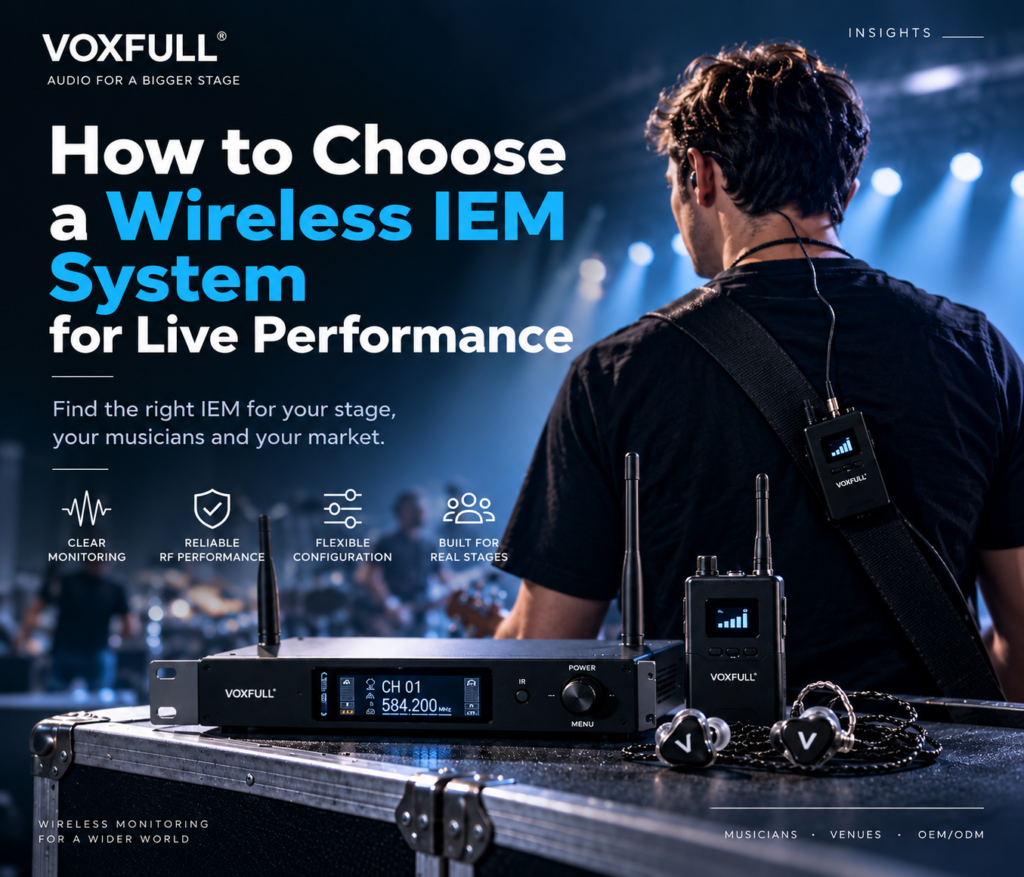
Wireless Monitoring · VOXFULL Insights
Choosing a wireless IEM system for live performance looks simple until you actually start comparing products.
Frequency band. Stereo or mono. Latency. RF power. Number of channels. Frequency scan. Transmission range. Bodypack design. One transmitter with multiple receivers.
The specification sheets get long very quickly.
But after developing and testing different wireless in-ear monitoring systems at VOXFULL, we have found that the most useful question usually isn’t:
“Which IEM has the best specifications?”
It is:
“What kind of stage is this system going to work on?”
A singer performing in a small club, a four-piece band playing weddings every weekend, and a rental company managing multiple wireless systems on a festival stage do not need the same IEM.
That is where we normally start.
Start with the Stage, Not the Specification Sheet
We manufacture several types of wireless monitoring systems at VOXFULL, from compact 2.4GHz portable IEM systems to UHF stereo rack-mount systems.
One thing became clear as the range developed:
There is no reason to make every IEM bigger, more powerful and more complicated.
Sometimes the customer actually needs the opposite.
Our compact M7S 2.4GHz wireless IEM, for example, was developed around portability. The transmitter and receiver are small, rechargeable and designed for musicians who don’t want to carry another large rack system to rehearsals or small performances.
Our professional UHF products solve a different problem. Once you move into larger venues and more complicated RF environments, frequency selection, scanning, RF power, antennas and multi-system operation become much more important.
So before comparing IEM systems, divide the application roughly into three situations:
| Live Application | What We Usually Prioritize |
|---|---|
| Rehearsal / small performance | Portability, simple setup, low latency |
| Band / church / regular live venue | Stereo monitoring, RF flexibility, multiple receivers |
| Professional stage / rental | Frequency management, multi-system operation, RF architecture, rack integration |
This simple distinction eliminates a lot of unsuitable products before you even compare specifications.
1. 2.4GHz or UHF?
This is probably the question we receive most often when discussing a new wireless IEM project.
We manufacture both.
And we don’t believe one should completely replace the other.
For a small stage, 2.4GHz can make a lot of sense.
The advantage is straightforward: it is easy to use internationally, allows a compact product design and doesn’t require the same country-by-country UHF frequency planning.
That is one reason we developed the M7S as a compact 2.4GHz wireless in-ear monitor system rather than trying to turn it into another rack product.
Our current configuration is intended for roughly 80–100m open-area operation, with mono/stereo monitoring and a compact rechargeable design.
But notice the words open area.
We deliberately don’t translate that specification into:
“100 meters guaranteed on every stage.”
A crowded venue with Wi-Fi routers, smartphones and other 2.4GHz devices is not the same RF environment as an open-field test.
UHF becomes more attractive as the stage gets more complicated.
With our UHF platforms, we can build around features such as:
- Selectable frequencies
- IR synchronization
- Auto frequency scan on selected models
- Stereo / Mono operation
- Adjustable RF power on selected models
- Multiple receivers per transmitter
- Half-rack or 1U metal transmitters
- Multi-channel system configurations
This gives a sound engineer much more control over how the wireless system is deployed.
For a professional audio distributor, we therefore rarely frame the decision as:
2.4GHz = good, UHF = better.
It is closer to:
2.4GHz = portable and straightforward
UHF = configurable and scalable
The application decides which advantage matters more.
2. For IEM, Latency Is Not Just Another Number
Latency matters in any digital wireless audio system, but it deserves particular attention with in-ear monitoring.
The performer is not simply listening to music.
A vocalist may be hearing:
their acoustic voice + microphone signal + mixer processing + wireless IEM signal
at almost the same time.
If too much delay accumulates through that signal chain, the monitoring experience can start to feel unnatural.
This is why we are careful when evaluating new digital IEM platforms.
A product can connect successfully, have good range and still not become a product we want to develop.
For us, the test is not only:
Does wireless audio come out of the receiver?
We also put the earphones on.
We speak into the microphone.
We listen.
That sounds like an obvious test, but it catches something a specification sheet doesn’t always show: whether the system actually feels comfortable to perform with.
For B2B buyers comparing digital wireless IEM systems, we recommend looking at the actual latency specification—but also asking whether the supplier has evaluated the product as a monitoring system rather than simply as a wireless audio link.
3. Stereo or Mono? Don’t Assume Everyone Needs the Same Thing
We offer both mono and stereo wireless monitoring configurations, because the application changes the value of stereo considerably.
For a basic monitoring setup, mono may be enough.
A vocalist may simply need a clear mix of:
- Their own voice
- Instruments
- Backing tracks
- Click
But on a more developed stage, stereo becomes much more useful.
A stereo mix allows the engineer to create spatial separation between instruments. Instead of putting everything directly in the center of the performer’s head, guitars, keyboards, backing vocals and other sources can be positioned across the stereo image.
That can make a busy monitor mix easier to understand.
This is why stereo IEM systems become increasingly important as we move from our entry-level monitoring products toward professional UHF platforms.
But there is an important B2B point here:
Don’t add “Stereo” to the specification sheet just because it looks more professional.
Ask whether the target customer will actually use it.
If you are building a low-cost portable IEM for a beginner market, simplicity may matter more.
If you are supplying musicians, churches, rental companies and live venues, stereo becomes much more valuable.
4. How Many Musicians Need to Monitor?
This changes the system configuration immediately.
One common misunderstanding we see is that buyers think:
one transmitter = one performer.
That isn’t necessarily true.
On many wireless IEM systems, multiple receivers can receive the signal from one transmitter when they are configured to the same channel/frequency.
For example:
TX × 1 + RX × 4
can be useful when four performers are listening to the same monitor mix.
That can significantly reduce system cost.
But if those four musicians need four independent monitor mixes, the requirement changes.
You may need:
TX1 → Mix 1
TX2 → Mix 2
TX3 → Mix 3
TX4 → Mix 4
This is why, when an OEM customer tells us:
“I need an IEM for a four-person band.”
our next question should not simply be:
“How many receivers do you want?”
We need to know:
How many independent monitor mixes do you need?
Those are two different questions.
And they can lead to two very different system configurations.
5. Frequency Scan Becomes More Valuable as the System Grows
On a simple setup with one wireless IEM, manual frequency selection may be perfectly acceptable.
Add several wireless microphones.
Then another IEM.
Then wireless instruments.
Then another band performing at the same venue.
Now frequency management starts to matter.
This is why some of our professional UHF IEM platforms include automatic frequency scanning.
The purpose is practical: help the user identify a more suitable operating frequency instead of blindly choosing one.
We see this as a clear dividing line in product positioning.
Manual tuning / IR sync
Suitable for simpler systems where the user wants straightforward frequency control.
Auto frequency scan + IR sync
More appropriate as the number of wireless systems and RF complexity increases.
And these two functions should not be confused.
Frequency Scan helps find a usable frequency.
IR Sync transfers/synchronizes the selected frequency information to the receiver.
They solve different parts of the setup process.
This distinction sounds small, but it matters when comparing professional wireless IEM systems.
6. Don’t Buy an IEM Based on “100m Range” Alone
Range is one of the easiest specifications to market and one of the easiest to misunderstand.
We also publish transmission-distance specifications for our products.
But we prefer to state the test condition.
For example:
80–100m in open area
is much more meaningful than simply:
100M LONG RANGE
because actual wireless performance depends on the environment.
A live venue can contain people, walls, stage structures, LED systems, Wi-Fi equipment and multiple RF devices.
The performer’s own body also matters because the receiver is normally worn on the body and constantly moving.
So when we evaluate an IEM system, we care about more than the longest distance at which we can still hear audio.
We also look at:
How does it behave while walking?
What happens when the receiver changes orientation?
Does the audio start breaking up near the edge of coverage?
How does the system behave when other wireless equipment is operating nearby?
For live performance, usable RF coverage is more important than a headline distance number.
7. Receiver Design Is More Important Than It Looks
The transmitter normally sits somewhere safe.
The receiver does not.
It is clipped to a musician who is walking, sweating, jumping, turning around and occasionally dropping things.
We therefore pay quite a lot of attention to the bodypack side of a wireless monitoring system.
A practical receiver should be easy to operate without becoming too easy to operate accidentally.
Things we look at include:
Volume control
Can the performer adjust it quickly?
Display
Can the musician see the important information without going through several menus?
Battery status
Is remaining power easy to understand?
Headphone connection
Is it positioned sensibly for body-worn use?
Belt clip
Does it feel secure enough for a live performance?
Battery solution
Replaceable AA or rechargeable lithium—what makes more sense for the target user?
This is also why our monitoring range does not use one receiver concept for every product.
A compact rechargeable 2.4GHz receiver makes sense for portability.
For a professional UHF system used night after night, the priorities can be different.
8. Rack-Mount or Portable?
This is another decision that should come from the application.
Portable IEM
Products such as our compact 2.4GHz systems are designed around:
carry it → connect it → perform → pack it away
That suits:
- Individual musicians
- Small bands
- Rehearsals
- Mobile performers
- Small venues
- Online retail
Half-rack / 1U professional IEM
Rack-based UHF systems make more sense when the IEM becomes part of a larger professional audio system.
That might include:
- Wireless microphone receivers
- IEM transmitters
- Antenna systems
- Digital mixer
- Power distribution
- Other rack equipment
At that point, mechanical format becomes part of the system design.
For rental companies and fixed venues, a metal rack-mount transmitter isn’t simply about looking “more professional.”
It makes the whole wireless system easier to install, transport and manage.
9. True Diversity: Useful, but Don’t Buy the Words
As we develop higher-level VOXFULL monitoring systems, True Diversity is one of the RF directions we are working with.
But this term also needs some caution.
Seeing two antennas on a receiver does not automatically prove that the system is True Diversity.
True Diversity refers to the actual receiver architecture—not simply the number of visible antennas.
That distinction matters to us because we don’t want to describe every dual-antenna product as a “True Diversity IEM.”
For professional buyers, the question should therefore be:
What RF architecture is actually inside the receiver?
rather than:
How many antennas can I see?
For a simple stage, advanced diversity architecture may not be necessary.
For demanding professional applications where RF reliability is a major purchasing factor, it becomes much more interesting.
10. Think About the Entire Wireless System
This is probably the biggest difference between buying your first IEM and building a professional wireless system.
On a small stage, you may have:
2 wireless microphones + 1 wireless IEM
Easy.
On a larger stage, you may have:
8 wireless microphones
4 IEM mixes
wireless instruments
Wi-Fi control for the digital mixer
other RF equipment
Now the question is no longer:
Which IEM should I buy?
It becomes:
How should I design the wireless system?
Frequency planning, antenna placement, RF power and physical installation all begin interacting with each other.
That is why our higher-level VOXFULL IEM development is moving beyond simply adding more channels.
We are paying more attention to the RF architecture of the complete system.
For professional monitoring, that is ultimately where reliability comes from.
Our Practical IEM Selection Guide
If a customer asks us to recommend a starting point, we would roughly divide the VOXFULL range like this:
Portable / Entry-Level Live Performance
Compact 2.4GHz Wireless IEM
Best suited to individual musicians, rehearsals, small bands and portable applications.
Typical priorities:
Compact · Rechargeable · Simple · Easy to Carry
Our M7S belongs in this category.
Regular Stage / Band / Church
UHF Stereo Wireless IEM
Better suited to musicians who perform regularly and need more RF flexibility.
Typical priorities:
UHF · Stereo/Mono · IR Sync · Selectable Frequencies · Multiple Receivers
This is where our UHF monitoring range becomes more relevant.
Professional Venue / Rental / Larger Stage
Professional Rack-Mount UHF IEM
Designed around larger wireless systems and more demanding live environments.
Typical priorities:
Auto Frequency Scan · Stereo · RF Control · Multi-Channel Configuration · Rack Integration
Demanding Professional RF Applications
Advanced RF / True Diversity IEM
This is the direction of our higher-level monitoring development.
Typical priorities:
Advanced Receiver Architecture · RF Reliability · System Scalability · Professional Wireless Integration
Not every customer needs this level.
And that is exactly the point.
There Is No “Best Wireless IEM” Without an Application
When we talk with customers about a new wireless in-ear monitor system, we prefer not to start with the most expensive model.
We start with a few questions:
Where will it be used?
How many musicians are on stage?
How many independent monitor mixes are required?
What other wireless equipment is operating at the same time?
Which country will the system be sold in?
Does the customer prioritize portability or RF flexibility?
Once those questions are answered, choosing the system becomes much easier.
That is also how we are building the VOXFULL wireless monitoring range.
Not one IEM for everybody.
But different wireless monitoring platforms for different jobs—from compact 2.4GHz wireless IEM systems to professional UHF stereo and advanced RF monitoring systems.
Because on a real stage, the best IEM is not the one with the longest specification sheet.
It is the one the musician can stop thinking about once the performance starts.
Looking for a Wireless IEM System for Your Market?
VOXFULL develops wireless in-ear monitoring systems for musicians, professional audio distributors, music stores, venues and OEM/ODM projects.
Our current product direction covers compact 2.4GHz systems, UHF mono/stereo IEM, professional rack-mount monitoring and higher-level RF platforms.
For B2B projects, tell us:
Your market + application + number of performers + required monitor mixes.
We can help you work backwards from the application to the right system configuration.
EXPLORE WIRELESS IEM SYSTEMS →