
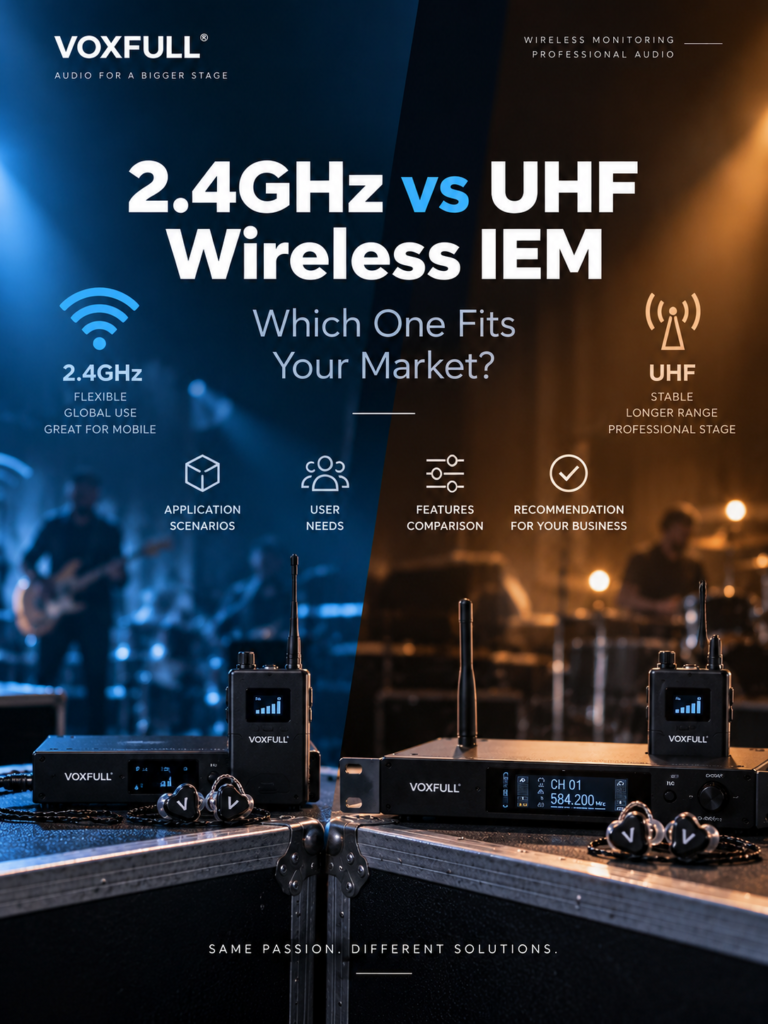
Wireless Monitoring · VOXFULL Insights
When buyers first start building a wireless in-ear monitoring product line, one of the first questions is usually:
Should we choose 2.4GHz or UHF?
We hear this question regularly from distributors, audio brands and customers developing their own IEM product range.
After working with different wireless monitoring platforms, our answer is usually the same:
There is no single frequency band that is right for every market.
A compact 2.4GHz system and a professional rack-mount UHF system may both be called “wireless IEM systems,” but in practice they are often purchased by different users, used on different stages and expected to solve different problems.
At VOXFULL, we therefore don’t look at 2.4GHz and UHF simply as two competing technologies. We look at them as two different positions in a wireless monitoring product line.
What We See from Our Own IEM Products
A good example is one of our newer products, the M7S compact 2.4GHz wireless IEM system.
When we developed this model, the idea was not to build another large rack-mount professional monitoring system. We wanted something much smaller and easier to carry, with a private-mold design that looks different from the many generic products already on the market.
The transmitter and receiver are compact, both have displays, and the system supports mono/stereo monitoring. In our current product configuration, it is designed for approximately 80–100 meters of open-area operation, with rechargeable portable hardware.
For a small band, rehearsal room, musician, mobile performer or online seller looking for a compact IEM product, this type of system makes sense.
But we would not tell a customer:
“This replaces every UHF IEM system.”
It doesn’t.
And that distinction is important.
Where 2.4GHz IEM Makes Sense
The biggest commercial advantage of 2.4GHz is actually easy to understand:
It makes wireless monitoring simpler.
Compared with UHF products that may need different frequency versions for different countries, the 2.4GHz ISM band is widely available internationally. That makes it particularly attractive for distributors and online sellers serving multiple markets. Professional wireless manufacturers likewise note the international usability and plug-and-play advantages of 2.4GHz systems.
For us as a manufacturer, we see another advantage.
A 2.4GHz IEM can be designed around a much more portable product concept.
Instead of thinking:
rack transmitter + bodypack + professional RF installation
we can think:
small transmitter + small receiver + rechargeable battery + carry case + simple connection
That changes not only the technology, but also who can sell the product.
Typical markets we would consider for a compact 2.4GHz IEM
- Small bands and musicians
- Rehearsal rooms
- Small stages
- DJs and mobile performers
- Music stores
- E-commerce sellers
- Entry-level wireless monitoring customers
- Markets where buyers want one SKU that is easier to sell across different countries
This is one reason we see 2.4GHz as an important part of our monitoring range rather than simply a cheaper version of UHF.
But 2.4GHz Has a Problem: Everybody Else Likes 2.4GHz Too
This is where specifications on a product page don’t tell the whole story.
2.4GHz is also used heavily by Wi-Fi and many other wireless devices. In a busy venue, that RF environment can be very different from an empty workshop or an open-area distance test.
Both Shure and Sennheiser point out that the shared nature of the 2.4GHz band can make congested environments more challenging.
This is something buyers should understand when comparing products.
If you see:
“Transmission Distance: 100m”
on a specification sheet, that does not mean the customer should expect exactly 100 meters in every venue.
Open-area testing and a real performance are two different things.
A stage may contain:
- Wi-Fi access points
- Audience smartphones
- Digital mixers and routers
- 2.4GHz instrument systems
- Wireless microphones
- Lighting/control equipment
- Metal stage structures
- Hundreds or thousands of people
RF performance therefore has to be considered as a system and environment question, not just a distance number.
This is also why maintaining line of sight between antennas and avoiding physical/RF obstructions remains important in wireless audio installations.
Why We Still Develop UHF IEM Systems
Once the application moves toward a more professional stage environment, the priorities start changing.
The buyer is no longer asking only:
“Is it portable?”
They start asking:
How many systems can I use?
Can I scan for a clean frequency?
Can I change frequencies when there is interference?
Is it stereo?
What is the RF output power?
Can one transmitter work with multiple receivers?
How stable is it when the venue becomes complicated?
This is where UHF becomes much more important.
Unlike a fixed global 2.4GHz band, professional UHF systems can operate across selectable frequencies, allowing the system to work around occupied spectrum when properly configured. Frequency scanning and coordination become increasingly important as the number of wireless systems grows.
This is why our UHF monitoring development goes in a different direction from M7S.
We currently work with UHF IEM configurations including:
Stereo / Mono operation
IR synchronization
Manual frequency adjustment
Automatic frequency scanning on selected platforms
Multiple receivers with one transmitter
Higher RF output options
Half-rack and 1U metal chassis designs
Multi-channel configurations
Dual-antenna and more advanced RF architectures on higher-level models
We are also developing the product line toward true-diversity and higher-level professional RF solutions.
That isn’t necessary for every musician.
But it matters much more to rental companies, professional venues and larger stages.
One UHF Frequency Version Does Not Fit the Whole World
There is also an important B2B issue that sometimes gets ignored:
UHF requires market planning.
A distributor cannot simply see “UHF” on a specification sheet and assume that the same frequency version should be sold everywhere.
Available spectrum and regulations differ by country and region. Professional wireless spectrum is a shared resource, and usable TV-UHF spectrum can vary substantially by location.
This affects the way we discuss OEM projects with customers.
For example, if a customer tells us:
“We want to sell this IEM in Mexico.”
or:
“This version is for South America.”
the conversation should not stop at:
“Yes, we have UHF.”
We need to discuss the actual frequency range and target market.
For a distributor, this creates a little more work than selling a 2.4GHz product—but it also allows the product line to address more professional applications.
This is one of the biggest differences between the two platforms from a B2B product-management perspective.
Don’t Compare Only the Frequency Band
Another thing we have learned from developing IEM products is that buyers sometimes give too much importance to the words “2.4GHz” or “UHF.”
Frequency band alone does not determine whether an IEM is good.
Two UHF systems can perform very differently.
So can two 2.4GHz systems.
When we evaluate a wireless monitoring platform, we prefer to look at several things together:
| What to Check | Why It Matters |
|---|---|
| RF architecture | Determines how the system handles the wireless environment |
| Available frequencies/channels | Important when multiple systems operate together |
| Frequency scanning | Helps locate usable spectrum |
| Mono / Stereo | Changes the monitoring experience and application |
| System latency | Especially important for digital IEM |
| RF output | Relevant to range and system planning |
| Antenna design | Affects practical RF performance |
| Receiver design | Important because the bodypack moves with the performer |
| Audio performance | RF stability means little if the monitoring sound is poor |
| Number of simultaneous systems | Critical for larger stages |
| Local frequency regulations | Essential for distributors importing UHF products |
That is a much more useful comparison than simply asking:
“Is UHF better than 2.4GHz?”
A Note About Latency
Latency deserves special attention in wireless monitoring.
With a microphone used for speech, a few additional milliseconds may go unnoticed.
With IEM, especially for vocalists, the situation is different because the performer is listening to their own voice while performing.
Industry technical guidance therefore treats IEM latency more critically than many other wireless applications. Shure, for example, recommends considering the total system latency—not just the wireless device—because digital mixers, processors and other digital stages can all add delay.
This is relevant to our own product development as well.
When we evaluate a digital IEM platform, we don’t want to look only at:
“Can it transmit audio wirelessly?”
We also have to look at:
“Does it still feel natural when a musician actually performs with it?”
Those are not the same test.
So, Which One Should a Distributor Choose?
Our answer depends on what role the product needs to play in your catalog.
Choose 2.4GHz when your priority is:
Portability + simplicity + international market flexibility
For example, a product like our M7S is better positioned for customers who want a compact wireless monitoring solution without moving immediately into a rack-based professional RF system.
It can also make sense as a traffic product or entry point into an IEM category for a music store or online seller.
Choose UHF when your priority is:
RF flexibility + professional stage use + scalable system configuration
For venues, churches, rental companies, larger bands and professional audio distributors, UHF usually gives us more room to build the system around the application.
Industry guidance similarly places UHF as the preferred operating space for many professional live applications, particularly as wireless channel counts and RF-management requirements increase.
And if you are building a complete IEM product line?
Our preference is:
Don’t choose only one.
Build different products for different jobs.
How We Think About the VOXFULL Wireless Monitoring Line
This is the direction we are taking with VOXFULL.
We don’t want to build ten IEM models that are basically the same product with different front panels.
We would rather build a clear product ladder:
Portable Wireless IEM
Compact 2.4GHz / UHF systems for musicians, small stages and mobile applications.
↓
Performance Wireless IEM
Stereo UHF systems with more RF control for bands and live performance.
↓
Professional Wireless IEM
Rack-mount, multi-channel systems for venues, churches, rental and professional stages.
↓
Advanced RF / True Diversity IEM
Higher-level RF architecture for applications where wireless reliability becomes a much more serious part of the system design.
And we are continuing to evaluate other wireless platforms, including 5.8GHz, where they can solve a real application problem rather than simply adding another frequency label to the catalog.
That distinction matters to us.
The Better Question Isn’t “2.4GHz or UHF?”
After working with wireless monitoring products, we think the better question is:
Who will use the system, where will they use it, and what level of RF performance do they actually need?
A musician carrying a small monitoring system to rehearsal does not have the same requirements as a rental company coordinating multiple wireless systems at a large event.
Trying to serve both customers with the same IEM usually means compromising somewhere.
That’s why we see 2.4GHz and UHF as complementary technologies rather than direct replacements for each other.
For distributors and professional audio brands, the opportunity is not simply to choose the “better” frequency.
It is to build the right wireless monitoring range for your customers.
Building Your Own Wireless IEM Product Line?
VOXFULL develops wireless monitoring systems across compact digital and professional UHF platforms, with options for OEM/ODM, private labeling, frequency configuration, packaging and product-line development.
If you are planning an IEM range for your market, tell us your country, target customer and expected application.
We can start from there.
EXPLORE WIRELESS IEM SYSTEMS →
CONTACT VOXFULL →